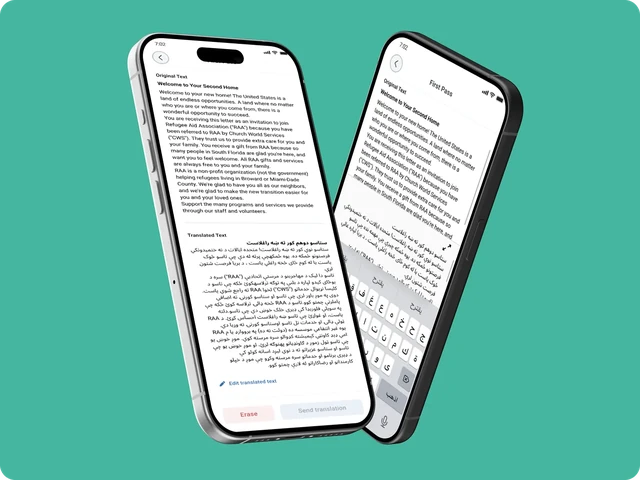
How the workflow works
The translator starts with an AI-assisted draft instead of a blank page.
The translator has to review and correct the AI draft before submitting it. AI helps with the first pass; the person still owns the final translation.
Translators can edit the extracted text and correct any part of the translated output before moving forward.
If someone tries to submit without making an edit, the product asks them to review the draft first.
Final submission requires an explicit approval so responsibility stays clear.
Overview
Tarjimly supports multilingual communication for refugees, nonprofits, hospitals and humanitarian organizations. Many document translation requests involve sensitive materials — medical letters, legal forms, housing documents, asylum records and personal identification.
Before FirstPass, translators often had to review each document manually from the beginning. This slowed down urgent cases and created pressure for teams handling high volumes of sensitive requests.
FirstPass was designed to help teams understand documents faster while keeping human review where it mattered most.
The challenge
The challenge was not adding AI. It was helping translators work faster without treating every AI output as correct.
The workflow had to support unclear uploads, sensitive content, AI uncertainty, review points and final human approval.
Initial findings
Translators needed speed, but not at the cost of accuracy.
AI output had to be framed as a draft, not a final answer.
Sensitive documents required human judgment.
Users needed clear states for extracted text, translated text, edits and final approval.
The product needed to discourage blind submission of AI-generated output.
Design goals
Reduce document processing time.
Keep human judgment central to the workflow.
Make AI-generated drafts easy to review and edit.
Make responsibility and approval clear.
Build trust in AI-assisted translation without overstating AI accuracy.
Design process
I audited the existing translation workflow and mapped where AI should help and where a translator needed to stay in control.
From there I worked through draft, review, warning, confirmation and approval states with product and engineering, then completed handoff and QA.
Designing with constraints
Unclear scans and low-quality uploads
Sensitive refugee documents
Multilingual content
AI uncertainty and confidence gaps
Need for human review before approval
Translation accuracy and cultural context
Mobile-first translator experience
Reusable patterns
The components and interaction states built for FirstPass were designed to be reusable across other AI-assisted workflows — not just document translation.
Launch and quality
The workflow was tested across different document types, language directions, edge cases and submission states — including unclear uploads, documents with sensitive content, and scenarios where translators attempted to skip the review step.
Design QA focused on ensuring the warning states, review prompts and approval flows worked as intended and that translators understood their role in the process before submitting.
Results
FirstPass helped reduce average document translation time from 37 minutes 54 seconds to 4 minutes 50 seconds, an improvement of approximately 87%, while keeping translators in control of review, correction and final approval.
The workflow helped refugees receive faster access to medical care, legal aid, housing support and case assistance — without removing the human judgment required for sensitive documents.
What this project reinforced
FirstPass reinforced something I keep coming back to in AI products: automation should remove unnecessary work, not remove human judgment.
The AI made the first draft faster, but the translator still owned review, correction and approval. The important part was designing those review points clearly.